
Enterprises have an enterprise wide security
policy;
Enterprises have enterprise wide
classification of data for security, risk, and business impact;
Enterprises have security related standards
and procedures;
Enterprises have formal security based
documentation, auditing, and testing in place;
Enterprise enforce separation of duties; and
Enterprises have policies and procedures in
place for Change Management, Help Desk, Service Requests, and changes to
applications, policies, and procedures.
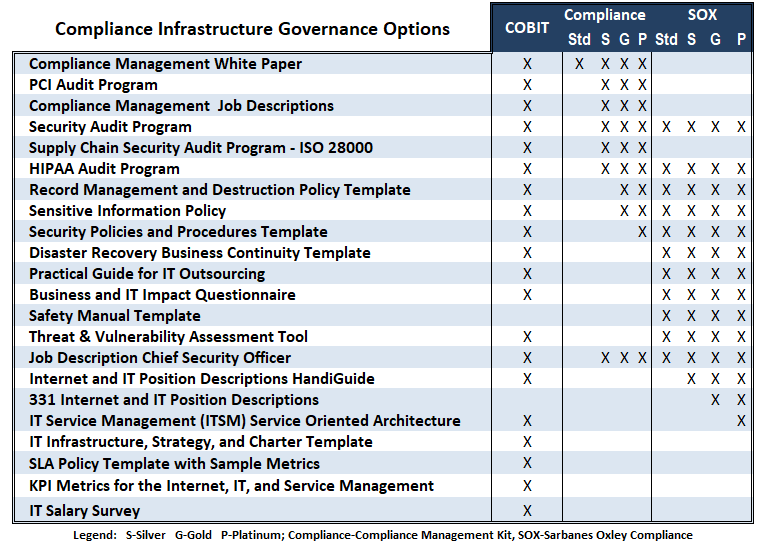
To meet these needs the Sarbanes Oxley
Compliance Resource Kit, which comes in four editions (Standard, Silver, Gold,
and Platinum) contains:
Business & IT Impact Questionnaire Risk
Assessment Tool (all editions);
Safety Program Template (all editions);
Disaster Recovery Template (all editions);
Outsourcing guide update to reflect what you
vendors need to do (all editions);
Software tool to monitor key data files (all
editions);
Internet and IT Job Descriptions (Silver,
Gold, and Platinum Editions) and;
IT Service Management Template (Platinum
Edition).
Security Manual
The plan is 178 pages and includes
everything needed to customize the Internet and Information Technology
Security Manual to fit your specific
requirement. The electronic document includes proven written text and
examples for your security plan. View
The Table of Contents And A Few Pages
Disaster Recovery Plan (DRP)
This Disaster Recovery Plan (DRP) can
be used as a template for any enterprise. DRP is sent to you via e-mail in WORD
and/or PDF format. Included is a 13 page Business Impact Questionnaire
as well as a 3 page Job Description for the Disaster Recovery Manager. View a the Table of Contents and sample pages [Adobe PDF]
IT Job Descriptions
The 220 Internet and IT Position
Descriptions are in Word for Windows format. Includes positions
from CIO and CTO to Wireless and Metrics Managers.
View The Table
of Contents And A Few Pages
The
IT Service Management Template
The IT Service Management Template contains policies, standards, procedures
and metrics for Change Control, Help Desk and Service
Request processing. ITSM template also contains
several easy to implement forms and conforms
with ITIL. View The Table
of Contents And A Few Pages
Safety Program is 60 pages and includes
everything needed to customize the Safety Program to fit your specific
requirement. The Safety was updated in December of 2004 and
reflects the latest issues associated with the most recent
legislation (Sarbanes Oxley).
When the Indian SMS-based social network GupShup polled Indian workers
in that nationÂ’s technology hubs, it got quite a surprise. Tech workers in Bangalore,
the biggest technology outsourcing hub in India said they felt that they
understood the anger of American workers at losing their jobs to outsourcing.
According to the companyÂ’s Senior Director and Head of Marketing Vishal Nongbet,
45 percent of Indian workers polled understand the American sentiments, but
nevertheless are proud of the jobs they do for American companies.
SMS GupShup is IndiaÂ’s largest social network, and unlike social networks in
the United States, is SMS-based because a large percentage of Indians have cell
phones, but relatively few have access to the Internet through a computer or
smartphone.
To many Indians, and to many American workers, the issue of outsourcing and
the issue of foreign workers coming to the United States on temporary work visas
are closely tied. Many people see both issues as vehicles for giving jobs
formerly done by U.S. workers to workers from other nations. In fact, Nongbet
said most Indians expected the current attempt to pass an immigration bill that,
among other things, would raise the cost of H-1B visas to $2000.00 will
proceed.
In the year 2020, technical expertise will no longer be the sole province of
the IT department. Employees throughout the organization will understand how to
use technology to do their jobs.
Yet futurists and IT experts say that the most sought-after IT-related skills
will be those that involve the ability to mine overwhelming amounts of data,
protect systems from security threats, manage the risks of growing complexity in
new systems, and communicate how technology can increase productivity.
Data Analysis - Demand will be high for IT workers with
the ability to not only analyze dizzying amounts of data, but also work with
business units to define what data is needed and where to get it. These
hybrid business-technology employees will have IT expertise and an
understanding of business processes and operations. They are people who
understand what information people need and how that information translates
into profitability.
Risk Management - Risk management skills will remain in
high demand through 2020, especially at a time when business wrestles with
growing IT complexity. Think of IT problems on the scale of BP's efforts to
stop the Gulf of Mexico oil spill, or Toyota's work to correct sudden
acceleration in some of its cars. Businesses will seek out IT workers with
risk management skills to predict and react to these challenges.
Robotics - Robots will have taken over more jobs by 2020.
IT workers specializing in robotics will see job opportunities in all markets.
Robotics jobs will involve research, maintenance and repair. Specialists will
explore uses for the technology in vertical markets. For example, some
roboticists might specialize in health care, developing equipment for use in
rehabilitation facilities, while others might create devices for the
handicapped or learning tools for children.
Securing information - Since we're spending more and more
time online, verifying users' identities and protecting privacy will be big
challenges by 2020, because fewer interactions will be face-to-face, more
personal information may be available online, and new technologies could make
it easier to impersonate people. Teleworkers will also represent a larger
portion of the workforce, opening up a slew of corporate security risks.
Running the network - Network systems and data
communications management will remain a top priority in 2020, but as companies
steer away from adding to the payroll, they will turn to consultants to tell
them how to be more productive and efficient based on predictions from the
U.S. Bureau of Labor Statistics.
Pure computer programmers are going the way of the typing pool. So are
one-dimensional technology specialists like network engineers. Deeply technical
professionals with multiple certifications in virtualization, networking and
security technologies work primarily as component engineers and IT architects.
Job titles include cloud architect, cloud capacity planner, cloud infrastructure
administrator and integration architect.
CIOs and IT employment experts, including Janco Associates, Inc. predict that this
bifurcation of IT roles will vastly accelerate, with most professionals falling
into one of two major categories: technical specialists and business
specialists.
The people who work in these roles design and maintain the underlying
framework or architecture. On top of this architecture sits a shifting inventory
of cloud services, plug-and-play Web-based applications and easy-to-use
proprietary software components that together represent the key source of a
company's competitive advantage.
Technical Specialists
Technical specialists are the people who work in a They kinow about data
standards, information standards, virtualization, networks, mobile technology
and IT architecture, among other things.
Organization will have far fewer people than today's IT department, but these
workers will have an extremely rich set of technical skills, and they will
understand precisely how their business makes and loses money and how all
transactions flow through the enterprise.
This is where the enterprise's overall business process and technology
architecture will be maintained. The infrastructure will be made up of multiple
services furnished by a variety of outside suppliers, coupled with software
components that were designed both externally and in-house and that are
extremely intuitive and easy for various business functions to assemble and use
competitively.
All indications are that by 2020, a big chunk of technical specialists' work
will involve integrating a broader array of technologies and services into the
overall enterprise infrastructure, CIOs say. That's why a broader set of
networking, software, virtualization and other skills will be required.
Business Specialists
The work of business specialists is matching the right IT tool to the
business need at hand. These are super-IT-savvy business experts who understand
how the business works, how transactions flow, what makes and loses money for
the company, and where and how technology can help or hinder the business.
This is where the upwardly mobile career action is, as well as the greatest
coolness factor.
IT's future revolves along three interrelated dimensions all of which
converge in the IT career track. They are:
Innovation, which he defines as the ability to convert ideas into money;
Business analytics, which involves operations research, data mining, data
integration, reporting and statistics; and
Risk management, which requires a keen knowledge of business processes.
By 2020 technology will be easier to use and it will be more prevalent in
other parts of the business and not just the purview of IT. It is about
having employees who are versatile and who know various technologies and
business processes. It makes us more flexible and reduces risks. Rotation
creates versatility.
The CIO role becomes much more about how to use technology to help the
business rather than how we provide the technology.
The U.S. is reviewing whether the new $600 billion border security law
for improved surveillance of illegal immigrants on the U.S.-Mexican border that
increases visa fees on H-1B visas is compliant with World Trade Organization
(WTO) rules. Visa fees on H-1B and L visas paid by these foreign companies
by roughly $2,000 per visa application.
The new law will affect Indian and other outsourcers outside the U.S. who
bring staff in large numbers to do work in the U.S., but it will not affect U.S.
tech companies who also use workers from abroad. As U.S. tech companies are
based in the U.S., their staff from abroad are typically less than 50% of their
total staff in the U.S.
The total cost to all Indian outsourcers from the new measure could be
collectively as much as $250 million a year. That is not a very large cost for
Indian outsourcers to bear, considering that their revenue runs into billions of
U.S. dollars, an analyst at a major research firm. But the same analyst is
worried that the visa fee hike could be just the beginning of other
protectionist measures by the U.S.
The new border security law has been criticized as discriminatory by India's
National Association of Software and Service Companies (Nasscom), as it singles
out companies that have more than 50% of their staff in the U.S. on these visas.
The Indian outsourcing model involves deploying a large number of staff
temporarily on customer projects in the U.S.
-
more H-1B Visa program tied to Border Security in the US Senate
Senators will seek to restrict visa program, saying H-1B use has created
'multinational temp agencies' that discourage U.S. students from entering the
tech field. Job Descriptions
are required for H-1B employees that show these positions can be taken by
recent college graduates.
One key Senator says that the H-1B program has created
"multinational temp agencies" that undercut U.S. wages and discourage students
from entering tech fields.
Speaking on the Senate floor in advance of its approval Thursday of $600
million for border security that includes an H-1B visa fee increase, said the
H-1B program has morphed into program used to hire foreign tech workers "willing
to accept less pay than their American counterparts."
The border security bill imposes a $2,000 fee increase on those firms that
have 50 percent or more of their U.S. employees on H-1B and L-1 visas. That
bill, which funds 1,500 new border officers and unmanned drones, awaits the
president's signature.
The Senate had previously approved the border security bill, but when it
included the visa fee increase further House action was needed, and the Senate
had to act again.
-
more Never Write Another Job Description From Scratch
If you plan to add new IT positions or re-organize your IT department in the
near future, the IT Job
Description HandiGuide will save you many hours of research. Detailed
job descriptions are the best way to communicate the responsibilities and
requirements to both prospective candidates and to the remainder of your
organization and they are already written for you!
Janco and eJobDescription.com have compiled complete descriptions for
the 230 most .IT positions. Each multi-page description contains a detailed
description of the responsibilities and of the recommended requirements for each
position. The documents are in Microsoft Word format and can be easily
customized to fit your unique needs.
You will save hours of time for each position you're hiring with this handy
resource.
The best way to show that you're valuable is to be valuable. Focus on how you
can deliver the most benefit to your employer, not on making sure everyone
notices how hard you're working or what you've achieved.
The most reliable way to keep your career moving forward is to build a track
record of consistent success. Things that you should do to standout in these
tough times include:
Impress the CIO and your key users - IT
reputations are built from the ground up. While you should always try to meet
your manager's expectations, your day-to-day working relationships with
colleagues are just as important. Assist your peers whenever you can without
spreading yourself too thin. After all, they're the ones who can step in and
help you meet a tight deadline.
Work longer hours smarter - Hard work is a
prerequisite for most IT positions, but that doesn't mean "the more hours, the
better." An extreme work schedule can actually lower your overall productivity
by wearing you out and leading to burnout. Regularly working late also might
be a sign that you're not managing your time well.
Become a specialist with a skill that is in demand
- CIOs will always rely on experts in specific technologies, but succeeding in
today's environment also requires an ability to expand beyond your job
description as needed. Don't pass up training opportunities or projects that
can help round out your skill set. By demonstrating that you're eager to
expand your core abilities, you make yourself more likely to be considered
when a chance for advancement arises.
Take charge and accept new responsibilities for things that you
can do - A can do attitude won't move your career forward if you
take on work that you can't, in fact, do. Indiscriminately volunteering for
projects that extend beyond your current abilities can create headaches for
the entire IT team. Ask yourself whether you have the appropriate skills and
experience for the job. Instead of volunteering to lead a project, would it
make more sense to play a supporting role in which you can learn as you go?
Focus on promotions that are meaningful - It's
easy to be blinded by a loftier title and higher salary, but before you accept
a promotion or a change in your current role, consider all the ramifications
of the change, including your work/life balance. Also think about the tasks
you most enjoy: Will you be able to devote as much time to them? All
advancement entails some uncertainty, but accepting a higher-level role just
for the pay and prestige can sap your satisfaction and lead to a career dead
end.
Do not engage in gossip and rumor spreading but be social and
network - Spending a little time every day to maintain personal
connections with people throughout the organization is essential to the health
of your career. These informal relationships strengthen your network and may
open the door to unforeseeable opportunities.
-
more IT Professionals react to continue economic downturn
(SHRM) - As the economic downturn worsens, employers are scrambling to trim
discretionary spending and, increasingly, to reduce payroll. Layoffs are on the
rise in the U.S. workforce, with 651,000 jobs cut in February 2009 for a total
of about 4.4 million jobs lost since December 2007. The overall national
unemployment rate was at 8.1% in February 2009, the highest monthly unemployment
figure since 1983. Even currently employed individuals are feeling the effects
of the weakened job market and cost-cutting measures - both within their
organizations and on a personal level.
The Society for Human Resource Management conducted a poll in January 2009 to
gauge workersÂ’ perceptions of the job market and the impact of the economic
downturn on employer benefits and personal financial behavior. The summary
results are:
Although one-half of workers felt that their jobs were not currently at
risk, only about one-third felt that their jobs would not be at risk if the
economy continued to decline over the next six months.
Nearly one-third of workers are likely to begin a job search or intensify
their job search when the economy and job market improve.
The most frequently reported action employees have taken in response to
the downturn in the economy was decreasing the use of credit cards and/or
cancelling credit card accounts.
CIOs need to
position themselves with their enterprises in order to be successful.They need to not only know where their
clients want them to go but also to communicate how they are achieving those
objectives.The objectives they
need to meet and the metrics that can be used are:
·Understand
requirements and objectives
– Frequency and number of requirements and objectives discussed with multiple
people at customer organization.
·Establish
company credibility and interest
- Company viewed as a leader with known corporate, technical and project
management teams in addition to solid past performance and
experience.
·Preview
preliminary solution with customer - Well-developed
solution with features linked to objectives and approach vetted with customer to
get buy-in and solution validation.
·Achieve
acceptance of win strategy (technical, management, past performance, teaming,
price) accepted by customer
- Win strategy well established, previewed and accepted by customer.
·Influence
the request for proposals
- Procurement strategy, proposal instructions, and evaluation criteria
favorable.
As part of a large downsizing
effort of its labor force in 2010, Indianapolis-based Eli Lilly is cutting 340
information technology jobs, according to an internal announcement.
Eli Lilly--which manufactures and markets drugs that fight cancer, diabetes,
fibromyalgia and erectile dysfunction, among others--announced last year it was
planning to cut costs of $1 billion in 2010, and the elimination of 5,500
workers is part of that cost reduction effort.
Eli Lilly has already seen about 140 layoffs, retirements and resignations in
IT in 2010, according to the The Indianapolis Star. John Russell, a reporter for
IndyStar.com, wrote the following on the latest round of layoffs:
"But it means 200 more information technology workers will lose their jobs
this year. The company said 115 of those cuts will take place this month.
Workers who are affected--or 'reallocated,' in Lilly parlance--are given several
months to look for another position within the company. But openings for
reallocated workers typically are extremely limited" Eli Lilly reported $5.486
billion revenue growth in the first quarter of 2010 -- a 9 percent increase from
the first quarter of 2009. The company expects to see large costs associated
with health care reform legislation that passed Congress and signed by the
president earlier this year.
"Lilly delivered strong operational performance in the first quarter, even as
we experienced continued weakness in the U.S. dollar versus prior periods and
began to account for the impact from recently enacted U.S. health care reform,"
said the CEO in the quarterly earnings statement "Our volume-driven revenue
growth remains solid and we are making the investments necessary to accelerate
the flow of potential new medicines through our pipeline."
Eli Lilly announced on July 2 that it entered a definitive merger agreement
to acquire Cambridge, Mass., biotechnology firm Alnara Pharmaceuticals, which
has been developing a drug to help combat pancreatic deficiencies and those
affected by cystic fibrosis.
Layoffs at Eli Lilly have not been isolated to IT; scientists, marketers,
public relations representatives, sales professionals and others have all been
let go from the company this year. Eli Lilly has roughly 40,000 employees
globally and claims to be the 10th largest pharmaceutical company in the
world.
-
more Department of Labor mis-classifies IT PRofessionals
The Department of Labor does not specifically identify millions of IT professionals
working in business lines, corporate departments, and in various enterprise
strategic and operational functions. These jobs require skills well beyond technology;
for instance, precise industry, customer, product, and solution knowledge and
expertise. Â… The fact is, the IT profession has undergone radical changes over
the past several years, blending seamlessly into the enterprise.
20 million U.S. IT pros? Of course there are far more than 4 million people
who use extensive IT skills to do their job, people who would not classify
themselves as anything like a software engineer or computer scientist. But
consider that there are about 51 million total managerial, professional, and
related workers in the U.S. Up to half of them are IT pros?
Job demand and salaries are up in
California's capital city, according to the Sacramento Bee. Not known as a
technology hub for jobs, it is a sign that about smaller cities like Sacramento
see an uptick in demand for technology talent.
At more than 500 open information technology positions for Sacramento, the
numbers are up by half from the same time last year. The tech job market in
Sacramento has improved significantly. There is solid demand for engineers,
project managers and programmers.
Officials at SARTA, the Sacramento Area Regional Technology Alliance, seeing
an uptick hiring. Other areas of the country like Austin, Texas and Raleigh,
North Carolina are also seeing technology job demand increases. Austin and
Raleigh are known for being smaller tech hubs due to the proximity to
universities and colleges. Companies in these cities are vying for talent as
hiring heats up in Silicon Valley, New York and other large metropolitan areas.
Job opening postings rose even more dramatically in traditional tech centers
such as Washington, D.C., New York and Silicon Valley, where job postings
increased 68 percent from the same time last year. The three metro areas
represent nearly a third of the website's available tech jobs.
-
more IT Professionals are satisfied in their jobs but are looking
The vast majority of IT professionals are satisfied at work with
40 percent are satisfied with their jobs. Indeed, Janco finds that there is
a direct correlation between job satisfaction and the salary. Since
more money equals greater job satisfaction, one could infer that for some, money
does buy happiness.
However, more than 60% of IT Professionals feel they should be
making more money. Though the majority of IT professionals seem to be
satisfied with their current jobs, it is not preventing almost 40% of them to
start looking for new opportunities. Nearly 1 in 5 are either actively
looking or will be looking within the next three
months.
-
more CFOs say IT salaries remain flat - recession is not over
Grant Thornton recently surveyed chief financial officerson a number of
economic and business topics. Almost half of surveyed "national" 496 chief
financial officers said they believe the economy will not come out of the
recession until 2011, and a quarter predicted that the recession will last
longer than 2011. Only 15 percent of tech CFOs surveyed said they think the
recession will be over after 2011. Forty-seven percent said they think it will
end in 2011, one-quarter expect it to end in the second half of 2010 and about
10 percent said they think the recession is already over.
Tech CFOs were more positive across the board. The 53 in that group were
feeling pretty decent about their budgets and hiring, but don't expect much of a
raise or bonus in 2010. Only 11 percent of respondents said they plan to give raises this year,
with 32 percent actually decreasing them this year.
In terms of hiring, 37 percent said they expect to increase headcount in the
next six months, compared with 29 percent in all other industries. Only 2
percent of tech CFOs said they expect to lay off employees, compared with 9
percent in every other industry. Over 80 percent of tech CFOs are keeping
headcounts flat. IT
Salaries have remained flat. From the report:
"Fifty percent thought that the U.S. economy would improve over the next six
months (versus 44% for their counterparts in other industries), 60% thought
their own company's financial prospects would improve (versus 52%), and 37%
thought the economy would come out of recession in 2010 (versus 28%). In terms
of inflationary pressure, only 17% were planning to raise prices in the next six
months, versus 24% for other industries."
-
more Colorado Inflation Adjustment Lowers Minimum Wage
Colorado's minimum wage will drop slightly in the new year - the
first decrease in any state's minimum wage since the federal minimum was adopted
in 1938.
Colorado's wage is falling 3 cents an hour, from $7.28 to the
federal level of $7.25. That's because Colorado is one of 10 states that tie the
state minimum wage to inflation. The goal is to protect low-wage workers from
having unchanged paychecks as the cost of living goes up.
But Colorado's
provision also allows wage declines, and the state's consumer price index fell
0.6 percent last year, so the minimum wage is going down.
The lower
consumer price index, attributed to lower fuel prices, would have forced the
wage down 4 cents an hour, But no state can go below the federal minimum of
$7.25.
Thirteen other states and the District of Columbia will keep a
minimum wage higher than the federal minimum, according to the U.S. Labor
Department. Alaska will join them Friday when its minimum wage rises 50 cents to
$7.75.
Colorado's drop is small - but those among the estimated
48,000 residents earning the minimum shook their heads at the possibility of pay
cut.
-
more