
ITIL - Implementation
Using the
IT Service Management for
Service-Oriented Architecture
Template to implement ITIL

The IT Service Management for SOA architecture is compliant with the latest defined ITIL and ISO 20000 standards.
Information Technology Infrastructure Library (ITIL) is a consistent and comprehensive documentation of best practice for IT Service Management. Used by hundreds of organizations internationally, a whole ITIL philosophy has grown up around the guidance contained within the ITIL books and the supporting professional qualification scheme.
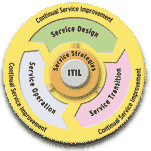
ITIL Version 3 was released in the spring of 2007 and ITIL 3.0 is structured around a core of Service.
- Service Strategy
- Service Design
- Service Transition
- Service Operation
- Continual Service Improvement
The processes that are addressed in that standard are:
- Access Management
- Availability Management
- Capacity Management
- Evaluation
- Event Management
- Financial Management (aka Service Economics)
- Information Security Management
- Knowledge Management
- Problem Management
- Release and Deployment Management
- Request Fulfillment
- Service Asset and Configuration Management
- Service Catalog Management
- Service Continuity Management
- Service Level Management
- Service Portfolio Management
- Service Validation and Testing
- Supplier Management
- Transition Planning and Support
These process in turn are supported by six (6) functional areas. Each of these areas have policies and procedures that are contained in the IT Service Management Template.
ITIL Standards
Service Desk - (Help Desk Policy, Help Desk Standards, Help Desk Procedures, and Help Desk Service Level Agreement)
An effective "service desk" (Help Desk) can be a great asset to any enterprise. Getting accurate feedback on issues your users are having can only benefit your development efforts and ultimately, the users themselves. The key here is to make sure that the help desk is well-prepared to accept responsibility for support calls on your applications.
Janco recommends that you start working with the help desk at least six weeks before your first application release. If the help desk is mature, they will have aids for capturing application support requests. These will provide the initial information needed for the knowledge base. The help desk personnel will augment that knowledge base over time with solutions and user work-around(s) as they come up with. Be sure to weed out the "false solutions."
There should be a complete distribution list for ticket reports from the help desk to all of the key managers and users in the enterprise. These will disclose what issues users are encountering. Commonly recurring or high-impact issues should become the focus of everyone involved. This then feeds the priority setting process in the Problem Management process.
Incident Management (Help Desk Procedures, Service Request Policy and Service Request Standard)
ITIL defines an "incident" as any disruption to the normal operation of a system or application. This includes bugs, outages, and even user interface problems. The Incident Management process begins with notification of an incident. This can be logged by the help desk in response to a user call. It can even be automatically created by a monitoring system. It marked as completed when normal functioning of the system is restored.
Note that this does not include root cause analysis or correction! Incident Management is all about restoring service.
Ideally, the help desk handles the entire Incident Management process. In less ideal cases, development may be called on to help resolve "novel" incidents--ones that do not have a solution in the help desk's knowledge base.
When incidents come into the development room, you have some negatives that need to be dealt with. The incident needs to be resolved expeditiously, making it both interrupt driven and urgent. Therefore, every incident will automatically take somebody off their current assignment. This is damaging to flow.
In worse cases, the entire team may get derailed and start huddling around the incident. Fire-fighting is exciting and many help desk professionals like to work them. If the entire team is chasing the incident, nobody is making forward progress on scheduled tasks. If you have a large user community or a lot of incidents, you can lose an entire day or weeks before you realize it.
This can be exacerbated if your help desk never resolves application support incidents. In such cases, Janco recommends the "Center-Post" position. Assign one member of the team to be the primary point of contact for incident resolution.
Problem Management (Help Desk Procedures, Service Request Policy and Service Request Standard)
Recurring incidents can be identified as Problems that require correction. This is the job of the Problem Management process.
Identifying a problem is often done by the help desk, but it can also come from others. The decision about which problems require correction and which ones have top priority often becomes very slow and bureaucratic. Janco has seen teams get chewed out for fixing problems that weren't scheduled to be addressed for a couple of iterations!
Problem managers should be encouraged to communicate via status reports. There also is a need to communicate back to the user community when the status of a problem changes. Good Problem Management classifies problem states such as "known problem", "known workaround", and "known solution". A help desk team will typically move through these states pretty quickly.
Bear in mind that the ITIL definition of Problem Management is all about oversight, not the actual changes needed to fix the problem. The actual changes are deployed as part of Release Management.
Change Management (Change Control Standard, Change Control Quality Assurance Standard, Change Control Management Workbook, Version Control Policy, and Version Control Policy)
Change Management is the most complex part of the ITIL standard. This is the process that so easily slips into heavyweight bureaucracy or, worse, meaningless meetings.
Change Management as defined simply means tracking changes, their impact to configuration items, and ensuring that changes are applied in an orderly way. It doesn't have to hurt.
In reality, however, help desk will spend a lot of time preparing for change management committee (CMC) meetings.
Janco recommends standardizing your change and deployment process (per the standards defined in the template). Get into a regular rhythm of releases and deployments so the CMC comes to expect that every third Tuesday (or whenever), your team will have a new release. Standardize the release mechanics and system impact statement so you can standardize and re-use your change requests. Familiarity will create confidence with the CMC.
Configuration Management (Documentation Standard, Version Control Policy, and Version Control Policy)
Configuration Management (CM) is not the act of changing configuration items. It's the process for tracking planned, executed, and retired configurations. As you plan each release, you should identify the places that will be affected by the release.
In a well-executed ITIL rollout, CM is vital
for change management, incident management, the help desk, and
release management. In a poorly-executed ITIL rollout, configuration
management does not exist, or it only addresses servers or network
devices.
CM should cover servers, network topology, applications,
business processes, documentation, and the dependencies among all of
them. That way, proposed changes to one area (e.g., upgrade to
front-end firewalls) can be analyzed for its impact.
Release Management (Documentation Standard, Version Control Policy, and Version Control Policy)
Release Management dove tails with Information Technology's release planning cycle. Engage early.
ITIL News
Cloud Process Benefits Defined
The benefits that that come from Cloud Processing and the associated infrastructure transformation include:
- Improvement in application performance

- Hardware reduction
- Reduce system administration overhead
- Reduce carbon footprint
- Power savings
- Savings in software licenses
- Faster job submissions
- Downtime avoidance
- Reduce compliance and ISO 9001 validation time
- Single path to support
- Warranty savings
Janco also points to other less tangible advantages that cloud processing achieves, such as: higher employee productivity, better performance across its infrastructure and avoided costs of outages. Additional savings and efficiencies, such as from virtualization, casn be expected as the cloud process continues to expand.
- more infoFirefox releases 4.0 Beta
Mozilla has launched the fourth beta of Firefox 4, adding bookmark and password synchronization, and revamping how people wrestle tabs.
The latest build supports the first attempt at accelerating Firefox 4's page rendering by tapping the graphics processor. The hardware acceleration, available only in Windows Vista and Windows 7, is disabled by default.
Trends in Browser Market Share
Firefox 4 Beta 4's most visible addition is "Panorama," a new name for what Mozilla had been calling "Tab Candy." Largely driven by the work of Aza Raskin, creative lead of Firefox, Panorama lets users collect tabs into sets, graphically displays those sets, and when users open a tab, shows only those tabs within the group.
Mozilla, which calls Panorama a tab manager, has argued that it's the next step in the evolution of tabs.
- more infoWindows 7 takes off
Windows 7 is success
A major finding in the report is that Microsoft's new Operating System, Windows 7 has 17.39% of the OS market less than 13 months after its availability. That is a major factor in Microsoft's improved record earnings. Janulaitis said, "The last time that an OS was accepted as quickly the market was XP. Vista's market share has peaked and is in the process of being decommissioned in most enterprises."
- more infoNew IT Metrics Program and Benchmark Program
Most IT Managers understand the importance of collecting, reporting and acting on performance metrics, but few put this knowledge into action in a meaningful way. Our partners at Janco Associates' recommend that all IT organizations develop and maintain a metrics program by focusing on simple metrics that address specific business issues like spending and staffing justification or performance improvement.
To help you identify and launch a metrics program that is meaningful to your specific business, Info-Tech has assembled the Metrics for the Internet, Information Technology, and Service Management HandiGuide. It is a collection of metric reports and tools designed to get your IT team's metrics program up and running quickly and easily. You will be given simple steps to creating a metrics program including the most important step: How to act on the results and improve IT performance to better serve the business.
- more infoMainframes and server farms are sources of productivity improvements
In the post-recession environment, the demand and supply mismatch between IT departments and the businesses they serve is growing. Business demands on IT are increasing while IT budgets have been cut.

The needs that IT can't address as a supplier, it can
address through other means. CIO can be a facilitators connecting the business
units to the services they need, whether internally or externally, such as from
a cloud or software-as-a-service provider.
IT is becoming more responsive, not because it can do more, but because it can acknowledge and help the business with more of their operationals needs. Productivity levels have improved
The path to value is taking some familiar and some new directions while also running into age-old issues.
Company have saved millions, mostly in cost savings, by putting new applications into a mainframe and on stand-alone servers environmens. The savings came from the smaller physical footprint, reduced cooling and power needs, and reductions in networking and systems administration work.
- more infoSocial networks hinder productivity
Social networks had already surpassed e-mail use among American Internet users. But according to a Nielsen Co. survey, online gaming is now also more popular that e-mail.
According to the Nielsen survey, Americans today are spending nearly a quarter of their online time posting comments, pictures and video on social networking sites like Facebook and Twitter, making it the most popular online activity among Americans.
Online gaming is the second most popular online activity, accounting for 10% of online use, while e-mail ranks third at 8.3%. In a survey completed in June, 2009, e-mail was the second most popular online activity, accounting for 11.5% of Inernet activity.
- more infoWorkforce mobility a productivity issue for CIOs
Part of the CIO's job is to support maximum productivity by choosing
appropriate infrastructure for
laptops and other devices to meet the individualized needs of
mobile employees. But IT leaders also must support the
mobile infrastructure in a way that is designed to minimize costs, simplify
administration efforts, protect against mobile-specific threats, and ensure
security. Key enablers of the mobile workforce include the following:
- Outstanding security and network accessibility
- Simple, intuitive systems and data management tools
- A streamlined process for backing up critical data
- Smooth transitions when changing hardware or software
Good metrics improve performance
When valid metrics are used, performance improves. Janco has found that these six rules need to be followed.
- Select metrics that relate directly to the factor that you want performance improved on
- Have at least four but not more than six metrics that are focused on a particular performance factor
- Set minimums and maximum values for each metric before you start
- Base metrics on at least two months of trend data
- Have metrics that are both leading and lagging indicators
- Set targets where actions will be taken when those thresholds are crossed
Service-Oriented Architecture and IT Service Management Are Keys To Success in the Recovery
SOA and ITSM drive success and productivity
One bad customer experience can cost you that customer for life. Hospitality, travel, retail, healthcare, and financial services are especially prone to losing customers who have a negative experience. It does not take much for a customer to decide that you and your company are not worth his time, effort, or money.Customers like to feel loved, and they are turned off very quickly when they sense that you do not care about the pain they are feeling. Even if you cannot help them because the situation is beyond your control, acknowledge that you understand both the situation and their frustration.
No
customer wants the person serving her to be distracted or preoccupied. Ever go
to the local mall and try to get help from a teenager focused more on texting
her friends than helping you find what youre looking for? On the other hand,
being too focused can be a bad thing. Have you ever asked an innocent question
out of curiosity and then found yourself stuck for an eternity while a customer
support person hunts endlessly for an answer? This person is likely so focused
on getting the answer that he does not realize that you really do not care that
much about it and would rather not wait for an answer to an inessential
question. Be sure your people understand the degree of focus required for the
job.
Even if the employee has the right skill set and experience, his odds of being successful and remaining on the job are low if his core behaviors and tendencies do not line up with those needed for success in that particular role. This is especially true for customer-facing roles in which your frontline employees act as extensions of your brand and heavily influence the customer experience.
- more infoIT Service Management drives customer satisfaction
Industry estimates peg the costs of acquiring new customers as being about five times more than the costs incurred to satisfy existing customers. IT Service Management and change control are keys to this process.
Customer retention and satisfaction also drive profits. According to some experts*, a 2 percent increase in customer retention can have the same effect on profits as cutting costs by 10 percent. And a 5 percent reduction in customer defection rate can increase profits by up to 25 to 125 percent, depending on the industry.
Additionally, existing customers are the ones who are most likely to be future purchasers. Theyve already shown they want and like your products or services and are willing to pay for them. And in many cases, customer profitability tends to increase over the life of a retained customer.
So whats the key to retaining customers? Keeping customers happy has always been a cornerstone of good business practice. But with today's economic conditions, delivering good service to ensure satisfaction has become critical to any companys success.
- more infoSecurity of wireless networks compromised by Google
Security of wireless networks is a concern of Connecticut Attorney General Richard Blumenthal who is heading up a 30-state investigation into Google's Wi-Fi data gathering scandal.
Blumenthal's investigation adds to the legal headaches for Google caused by the revelation that its Street View cars were collecting wireless "payload" data in addition to geolocation data from unsecured wireless hot spots. Ever since Google revealed the extent of its data gathering a month ago in response to inquiries from German regulators, lawyers and politicians have been lining up to express their outrage.
"Consumers have a right and a need to know what personal information--which could include e-mails, Web browsing, and passwords--Google may have collected, how, and why," Blumenthal said in a statement posted on his Web site. "Google must come clean, explaining how and why it intercepted and saved private information broadcast over personal and business wireless networks."
- more infoRecord mangement key to information goverance
Effective record management and information governance provides a
foundation for addressing the various challenges faced with electronic
information, including:
-
Management of information growth. Proactively monitoring and managing what content is being stored based on business value and record keeping obligations;
-
Mitigation of risk. Reducing risk and ensuring conformance with different regulatory, legal and business policies; and
-
Management of access to content. Driving competitive advantage and improving business operations through both access control and better re-use of information. Policy is at the heart of each of these challenges and key to an information governance strategy.
-
Information governance is most effective when policies can be carried forward consistently with enabling technologies. Foundational technologies at the core of a good information governance strategy include classification, security and access control, retention policy management, search, archiving and content management.
Recovery Point and Recovery Time Metrics
Recovery point objective (RPO) refers to the amount of data loss a customer can tolerate, specifically the point in time to which your enterprise must be able to recover the data. Some enterprises require an RPO of ZERO. That means the enterprise cannot lose a single committed transaction in the event of a site failure; they must be able to recover the data back to the zero minute of the time of the disaster. There are implications to setting up an RPO of zero. The replication solution will require synchronous replication (explained in detail later in this section) and may impact performance of the application being replicated.
An
RPO of greater than zero, for example 30 minutes, can be handled differently. An
RPO of 30 minutes means the customer can tolerate losing the last 30 minutes of
transactions in the event of a site failure. If the disaster occurrs at 12:00,
the customer must be able to recover the data to at least 11:30 (30 minutes
prior to the disaster). This can most likely be accomplished with asynchronous
replication with minimal performance impact to the application. In this
situation, careful planning and monitoring of the write-history log is essential
to support the expected RPO.
A RPO can only be
determined by their business rules and other governances of their environment.
The customer must weigh the risk of data loss in a higher RPO against the cost
and performance impact of a zero RPO.
Recovery time objective (RTO) refers to the amount of time it takes a customer to get their backup site up and running after a complete failure at the primary site. Most customers have an RTO of anywhere from 15 minutes to 8 hours, though the average is about 2 hours. This includes the time to failover the replicated LUNs (logical Unit Number) to the backup EVA (Enterprise Virtural Array) , recover the backup database and bring it online, and redirect any applications to the backup database server. A faster RTO can usually be accomplished by prestaging the backup site to the greatest extent possible.
Most Common Security Weaknesses - Sarbanes-Oxley Compliance
Security Manual Template has a solution
for each of these weaknesses.
1. Improper account provisioning with segregation of
duties
2. Insufficient
controls for change management
3. A general lack of understanding around key system
configurations
4. Audit
logs not being reviewed (or that review itself not being logged)
5. Abnormal transactions not
identified in a timely manner be considered abnormal or a violation of a
security policy within the network.
go to http://www.itproductivity.org/Security.htm
- more infoRisk management starts with risk assessment
There have been lessons learned from the current financial crisis in wasy to address perceived weaknesses in risk identification, assessment and management. The direction that CEOs and CIOs need to taker are:
- Risk management must be given greater authority
- Senior executives must lead risk management from the top
- Management needs to review the level of risk expertise in their
organisation, particularly at the
highest levels - Managers should pay more attention to the data that populate risk models,
and must combine
this output with human judgment - Stress testing and scenario planning can arm executives with an
appropriate response to events
Incentive systems must be constructed so that they reward long-term stability, not short-term
profit - Risk factors should be consolidated across all the business operations
- Managers should ensure that they do not rely too heavily on data from external providers
- A careful balance must be struck between the centralisation and decentralisation of risk
- Risk management systems should be adaptive rather than static
Common threads for security issues
A comprehensive survey compares findings of several security studies and finds that:
- Big jumps in incidence of password sniffing, financial fraud, and malware infection.
- Organizations often are fraudulently represented as the sender of a phishing message.
- Average losses due to security incidents are down again this year (from $289,000 per company to $234,244 per company), though they are still above 2006 figures.
- Twenty-five percent of companies felt that over 60 percent of their financial losses were due to non-malicious actions by insiders.
- Most companies are satisfied, though not overjoyed, with all security technologies.
- Most companies t their investment in end-user security awareness training was inadequate, but most felt their investments in other components of their security program were adequate.
- When asked what actions were taken following a security incident, 22 percent stated that they notified individuals whose personal information was breached and 17 percent stated that they provided new security services to users or customers.
- When asked what security solutions ranked highest on their wishlists, many named tools that would improve their visibility - better log management, security information and event management, security data visualization, security dashboards and the like.
- Companies generally said that regulatory compliance efforts have had a
positive effect on their organization's security
programs.
Improving knowledge worker productivity a CIO challenge
Many analysts support the notion of an integrated productivity environment for information workers. Many vendor frameworks combine these capabilities to create the next-generation workplace for information workers. The introduction of Microsoft Office 2007, Open Office and Google Documents are solutions with tight design integration, deliver the functionality that would have previously required 6 - 10 products for a full business productivity platform. The next releases of these products will take this integration to the next level by providing more flexibility in delivery and new capabilities to help improve productivity by saving the business time and money. - more infoChnage control and Quality Assurance Fail at McAfee
Change control and quality control fail at McAfee, as a result they released a product that caused thousands of customer PC to fail. McAfee has responded with the following statements:
How did this DAT file get through McAfees Quality Assurance process?
- Process Some specific steps of the existing Quality Assurance processes were not followed: Standard Peer Review of the driver was not done, and the Risk Assessment of the driver in question was inadequate. Had it been adequate it would have triggered additional Quality Assurance steps.
- Product Testing there was inadequate coverage of Product and Operating System combinations in the test systems used. Specifically, XP SP3 with VSE 8.7 was not included in the test configuration at the time of release.
What is McAfee going to do to ensure this does not repeat?
- Strict enforcement of rules and processes regarding DAT creation and Quality Assurance.
- Addition of the missing Operating Systems and Product configurations.
- Leveraging of cloud based technologies for false remediation.
- A revision of Risk Assessment criteria is underway.
What is McAfee going to do to prevent this from happening again?
- Nearly all of McAfee's 7,000 employees have been working around the clock to help customers get back to business as usual and to make sure this never happens again.
- McAfee is implementing additional QA protocols for any releases that directly impact critical system files. McAfee is rolling out additional capabilities in Artemis that will provide another level of protection against false positives by leveraging an expansive whitelist of critical system files and their associated cryptographic hashes.
Network Solution Sites Hacked Again
Securi Security Labs said that at least 50 sites hosted by Networks Solutions had been hacked and that malicious JavaScript injected into those sites was redirecting unsuspecting users to a Ukrainian attack server. The same server was involved in the earlier attacks against Network Solutions-hosted blogs.
Acccording to Computerworld a spokesman for Network Solutions said they have received reports that some Network Solutions customers are seeing malicious code added to their websites.
- more infoMany compliance isses faced by CIOs
Compliance with regulatory mandates and internal security policies is critical to the success of any enterprise. To protect the integrity of enterprise-owned information, prevent corporate scandals, and ensure customer privacy, new laws and regulations have emerged governing a variety of enterprises. Some of today's more prominent security mandates include:
- SOX - The Sarbanes-Oxley Act of 2002 requires strict internal controls and independent auditing of financial information as a proactive defense against fraud.
- HIPAA - The Health Information Portability and Accountability Act of 1996 requires tight controls over handling of and access to medical information to protect patient privacy.
- GLBA - The Gramm-Leach-Bliley Act of 1999 requires financial institutions to create, document and continuously audit security procedures to protect the nonpublic personal information of their clients, including precautions to prevent unauthorized electronic access.
- FISMA - The Federal Information Security Management Act of 2002 is meant to bolster computer and network security within the federal government and affiliated parties (such as government contractors) by mandating yearly audits.
- Basel II - The Capital Requirements Directive/Basel II Accord established an international standard that banking regulators can use when creating regulations about how much capital banks need to put aside to guard against the types of financial and operational risks banks face.
- UK Data Protection Act of 1998 - The eight principles of the Data Protection Act state that all data must be processed fairly and lawfully; obtained and used only for specified and lawful purposes; adequate, relevant and not excessive; accurate, and where necessary, kept up to date; kept for no longer than necessary; processed in accordance with individuals rights as defined in the Act; kept secure; and transferred only to countries that offer adequate data protection.
Some IT skills still in demand
Not much hiring is expected in the second quarter, but certain skills are in demand. Also, health care jobs for IT professionals are increasing, especially in software and consulting related to electronic medical records.
Seventy-nine percent of surveyed CIOs are feeling
optimistic about their companies' prospects for growth, and 40 percent are
planning for new projects. But that positive streak does not necessarily
translate into big growth in full-time hiring in the second quarter, according
to a recent hiring and skills report.
Only 9 percent of 1,400 CIOs polled for the Robert Half
Technology IT Hiring Index and Skills Report are planning new hires this
quarter. And with 4 percent expecting to cut jobs, the net gain in hiring is 5
percent, the outplacement company reported in early
March.
Telecommuting challenges
Teleworking - variously referred to as telecommuting, e-commuting, e-work, telework, working at home (WAH), or working from home (WFH) - is a work arrangement in which employees enjoy flexibility in working location and hours. In other words, the daily physical commute to a central place of work is replaced by telecommunication links.
Teleworking is not just an arrangement; it is a way of life. It requires changes in behavioral patterns that go beyond the usual. It also requires a lot of creativity to stay in touch with people inside and outside the organization. Most teleworkers have two lifelines to their organization -remote VPN access (for access to e-mail, calendar, and Intranet documents) and a telephone (for real-time communication). With no technical on-site support, a failure of even one of these lifelines leads to serious problems. Experienced teleworkers therefore prepare for the worst case scenario while all systems are working.
- more infoIT Infrastructure Cost Rising
Many of the largest IT budget problems can be traced back to five big money drains:
- Storage expansion - IT departments are already stretching their budgets for storage, and the demand is only going to grow. The volume of data an average business collects and stores actually doubles every 18-24 months.
- System complexity - a survey of Canadian IT workers show that many DBAs already devote up to 80 percent of their time to routine systems maintenance. Add to that the work that needs to get done on strategic projects, and you may be looking at major overtime charges.
- Hardware sprawl - More systems usually mean more complexity and maintenance and more servers definitely mean more power and cooling costs. For most companies, data center hardware accounts for the bulk of the power and cooling bill. In some cases, power costs can even exceed the cost of IT equipment!
- Reliability and scalability - most enterprise information is contained within IT systems, it is absolutely critical that those systems be available whenever your employees or your customers need them. Now you're talking about 24x7 availability, meaning that your systems have to scale along with your workloads. But scaling out by adding servers raises hardware and maintenance costs, and the wrong storage configuration can cause major delays in delivering key information.
- Compliance - Organizations face large fines if they are found to be out of compliance, and bad press and security breaches can dissolve shareholde confidence, destroy customer trust and send stock prices plummeting almost overnight.
Janco has solutions for these IT Infrastructure issues
- more infoFeds inches towards more control over Internet
Homeland Security and the National Security Agency may be taking a closer look at Internet communications in the future.
The Department of Homeland Security's top cybersecurity official said that the department may eventually extend its Einstein technology, which is designed to detect and prevent electronic attacks, to networks operated by the private sector. The technology was created for federal networks.
Is this the camel's nose in the tent?
- more infoVA revamps IT Infrastructure - cuts projects
VA infrastructure is changed and projects are cut.
To improve management of ongoing projects, as of Feb. 15 every IT project in the department, and about 250 IT projects overall, are being managed through the Program Management Accountability System introduced in July. The system requires IT projects to deliver new functionality within six months and to meet project milestones. The VA also is using an online IT dashboard to identify and track troubled projects.
The Veterans Affairs Department has terminated its Enrollment System Redesign, Pharmacy Reengineering and 10 other failing information technology projects for a projected savings of $54 million this fiscal year, officials announced today.
The goal is to put IT projects on the accountability system as soon as possible, it took several months to identify and terminate contracts associated with the canceled projects.
The enrollment systems project was budgeted at $24 million, and the pharmacy project at $23 million, for fiscal 2010.
Other canceled VA IT projects included the Barcode Expansion, Delivery Service, Rights Management Server and VA-Defense Department Laboratory Data Sharing and Interoperability terminology support.
The 12 canceled IT projects were among 44 IT projects halted by VA officials in July 2009. Chief Information Officer Roger Baker today released the list of the 12 terminated projects and 32 restarted projects.